
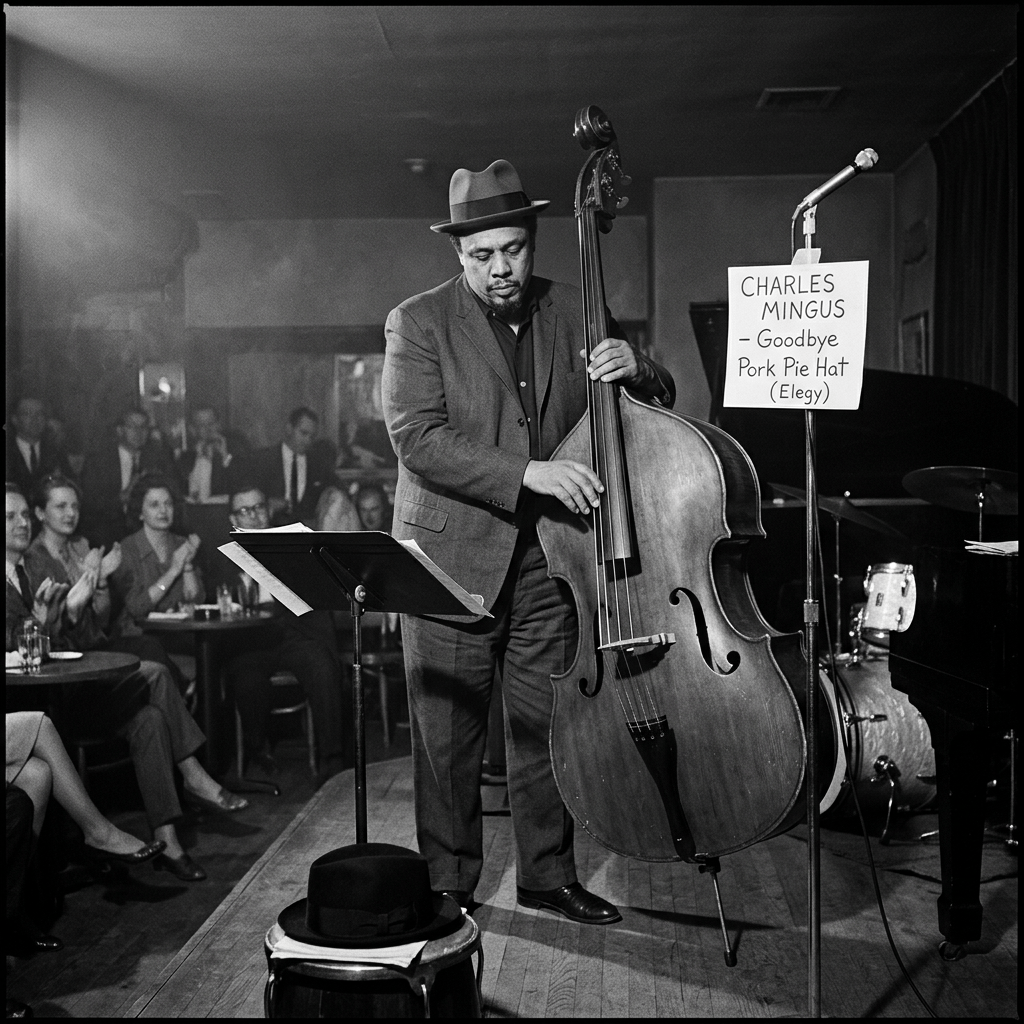
Charles Mingus’s jazz elegy and its most famous interpretations
My first encounter with “Goodbye Pork Pie Hat” came in high school, through Jeff Beck’s version on Wired. For me as a young guitarist, Wired and Blow by Blow were a paradigm shift: they opened the door to an entire world of jazz fusion and led me to John McLaughlin, Jean-Luc Ponty, Jaco Pastorius and many others. Beck’s version of “Goodbye Pork Pie Hat” remains one of my all-time favorite recordings. At that point, however, I had no idea who Charles Mingus was and had never heard the original recording. Fast-forward forty-five years: I still love Beck’s interpretation, but I can now appreciate the spare, haunting beauty of Mingus’s 1959 composition on Mingus Ah Um. Written as an elegy for tenor saxophonist Lester Young, Mingus began shaping the piece after learning of Young’s death while performing at New York’s Half Note club, transforming a slow, sorrowful blues into one of jazz’s most enduring memorials. Mingus Ah Um was added to the National Recording Registry in 2003. (loc.gov; dukeupress.edu)
“Goodbye Pork Pie Hat” is a memorial without ceremony. There is no grand introduction, no theatrical outpouring and, in its original form, no lyric explaining whom or what the musicians are mourning. Tenor saxophonists John Handy and Booker Ervin enter with a dark, closely voiced melody that sounds simultaneously dignified and wounded, moving between unison and octaves; at one exposed note they split into a biting dissonance, a small harmonic wound inside an otherwise blended line. Handy then steps forward with the deeply felt solo that gives the recording its most personal cry.
The composition is grounded in the blues, but Mingus surrounds that foundation with shifting bass movement, chromatic harmony and unresolved dissonances. The melody remains relatively clear while the chords beneath it continually change colour, creating the feeling that the music is searching for a resting place it cannot quite find. That harmonic uncertainty is essential to the piece’s power. A more conventional lament might resolve its tension and offer consolation. Mingus does not. His chords hesitate, darken and move sideways. The result captures something closer to the actual experience of grief: memories return repeatedly, but never in exactly the same form (newyorkjazzworkshop.com).
The original ensemble performance is remarkably restrained. Mingus’s bass does not dominate the recording; it supports and quietly unsettles it. Dannie Richmond’s drumming maintains a patient pulse rather than imposing a heavy funeral rhythm. Above them, the horns sound less like a conventional jazz front line than a group of mourners speaking in overlapping voices. The composition’s lasting achievement lies in this balance: it is memorable without being sentimental, harmonically sophisticated without becoming emotionally remote, and deeply personal while remaining open to reinterpretation. It is one of the finest examples of instrumental music communicating a precise human feeling without needing to name it.
Essential cover versions
Pentangle — Sweet Child (1968)
Pentangle’s live version, recorded at London’s Royal Festival Hall and released on Sweet Child, demonstrates how naturally Mingus’s composition can move outside conventional jazz instrumentation. The interlocking acoustic guitars of Bert Jansch and John Renbourn make the melody feel more fragile and exposed. Danny Thompson’s double bass preserves some of the original’s depth, but the overall sound intimate and almost chamber-like. Where Mingus’s horns suggest collective mourning, Pentangle’s arrangement resembles a private remembrance shared among a few musicians. It is one of the earliest and most persuasive examples of the song’s appeal beyond jazz.
John McLaughlin — My Goal’s Beyond (1971)
John McLaughlin included an acoustic-guitar interpretation on My Goal’s Beyond. (johnmclaughlin.com). His concise performance removes much of the ensemble drama and concentrates on the shape of the melody. Played on double-tracked acoustic guitars, the composition takes on a reflective, almost devotional quality. McLaughlin does not treat it as an opportunity for technical display and his precision instead reveals how strong Mingus’s melodic writing remains when nearly everything else is stripped away.
Jeff Beck — Wired (1976)
Jeff Beck’s interpretation on Wired is probably the most famous instrumental cover outside the traditional jazz world. The album places the piece within a 1970s fusion setting, with Beck accompanied by electric piano, bass and drums. Beck uses sustain, controlled feedback and delicate pitch bends to make his electric guitar behave like a human voice. Some phrases are whispered; others flare suddenly into anguish. The production is polished, but Beck’s performance retains a raw sense of vulnerability. It is both a respectful reading and a complete transformation.
Rahsaan Roland Kirk — The Return of the 5000 Lb. Man (1976)
Rahsaan Roland Kirk turned the instrumental into a vocal memorial on The Return of the 5000 Lb. Man, receiving a songwriting credit alongside Mingus for the adaptation. (allmusic.com). Kirk’s version is earthier and more direct than the original. The lyrics explicitly celebrate Lester Young, while Kirk’s unmistakable reed sound reconnects the song to the tenor-saxophone tradition it commemorates. By giving the elegy words, he sacrifices some of Mingus’s mystery but gains the intimacy of an oral tribute—one musician openly testifying to the importance of another.
Joni Mitchell — Mingus (1979)
Joni Mitchell’s version is the most ambitious vocal adaptation. Written while she was collaborating with Mingus near the end of his life, her lyrics draw on stories he told her about Lester Young, racism, segregated touring conditions and New York jazz culture. The recording appeared on Mitchell’s 1979 album Mingus, accompanied by musicians including Jaco Pastorius and Herbie Hancock. (jonimitchell.com)
Mitchell’s phrasing deliberately resists conventional song form. She stretches and compresses syllables to fit a melody that was never designed to carry words, making the performance feel precarious and intensely attentive. Because Mingus died before the album’s release, Mitchell’s performance also acquires a second layer of meaning: a song written by Mingus for Lester Young becomes, indirectly, Mitchell’s farewell to Mingus. That double remembrance makes it perhaps the most emotionally complex of all the covers.
Stanley Clarke — If This Bass Could Only Talk (1988)
Stanley Clarke placed the composition near the beginning of his 1988 album If This Bass Could Only Talk. Clarke’s bass-centred treatment brings the piece back toward Mingus’s own instrument while placing it in a more contemporary fusion setting. His interpretation is smoother and more expansive than the 1959 recording, yet it retains the melody’s solemn gravity.
Final assessment
The suggested covers do not replace “Goodbye Pork Pie Hat” and instead reveal different qualities already present within it. Pentangle uncovers its intimacy, McLaughlin its melodic purity, Beck its blues-rock intensity, Kirk its potential as direct testimony, Mitchell its historical and lyrical depth, and Clarke its enduring importance to bass players.
The original remains definitive because it withholds as much as it expresses. Mingus does not tell the listener exactly how to grieve for Lester Young. He creates a dark, beautiful space and allows each musician and listener to enter it in a different way.
AI disclosure: ChatGPT Pro GPT-5.6-Sol assisted with research organization and editing. The author independently verified the article’s factual claims and sources and takes responsibility for the final text.






Leave a Reply