
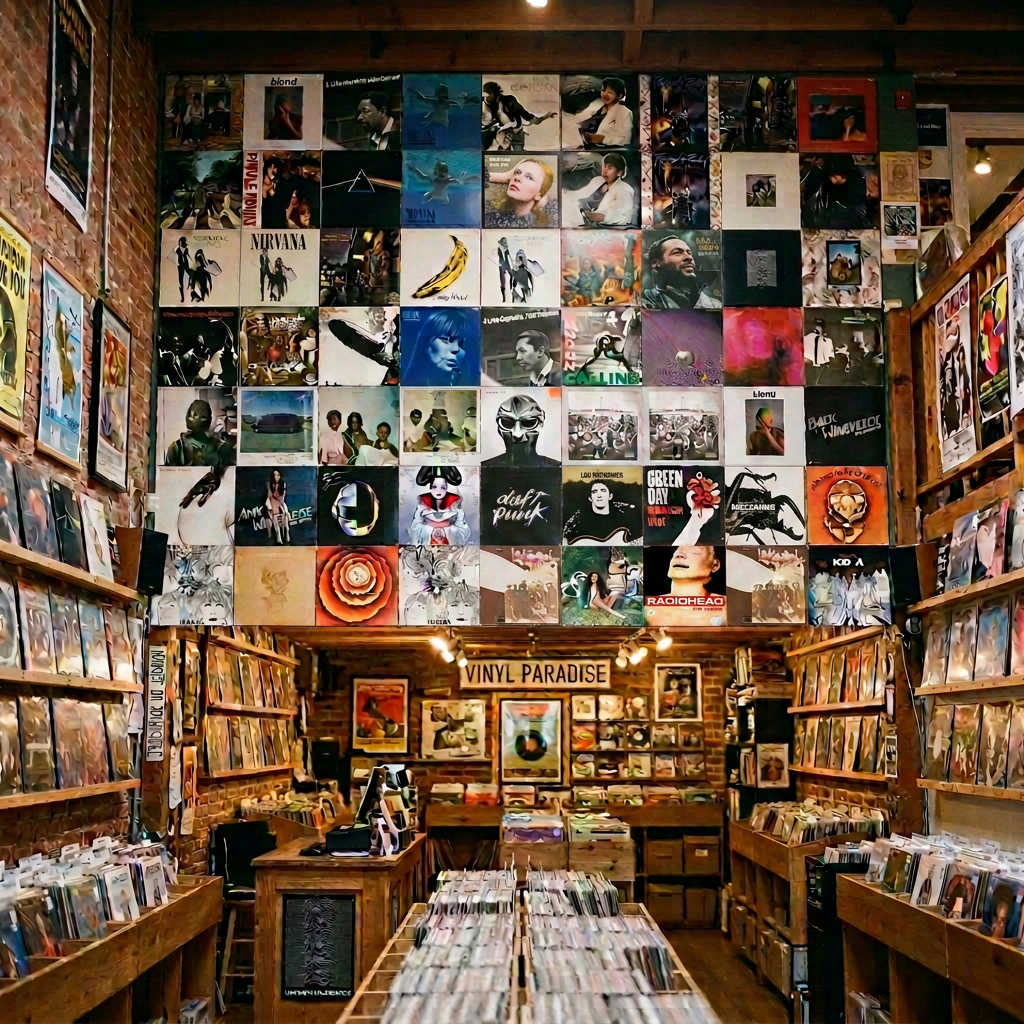
Welcome to the September 2026 edition of Listen to Music. A monthly walk across the musical spectrum.
“Angel from Montgomery” (Live) – John Prine and Bonnie Raitt
John Prine and Bonnie Raitt sang this duet live on January 26, 1985, at the Arie Crown Theater in Chicago. The concert was a tribute to their friend, the folksinger Steve Goodman, who had died of leukemia the previous September. It first came out on the double album Tribute to Steve Goodman (Red Pajamas Records, 1985). Prine then included it on John Prine Live (Oh Boy Records, 1988), which he co-produced with Dan Einstein and Jim Rooney. It’s best described as country-folk, with the song’s plain storytelling carried by acoustic guitars and two weathered voices. Prine and Raitt both sang and played acoustic guitar. David Bromberg added electric guitar, and Johnny Lee Schell played bass and sang harmony. Prine wrote the song for his 1971 debut album, and Raitt made it a staple of her own shows after recording it in 1974. The two kept performing it together until late 2019, just months before Prine died.
Sources:
- Tribute to Steve Goodman – Discogs
- John Prine Live – Wikipedia
- Angel from Montgomery – Wikipedia
- Angel From Montgomery (Live) – John Prine Bandcamp
- Oh Boy Records – SoundCloud
- American Songwriter – Prine and Raitt ACL performance
“Seasons” – Chris Cornell
“Seasons” is Chris Cornell’s first solo release. It’s the third track on the soundtrack to Cameron Crowe’s film Singles, released by Epic Soundtrax on June 30, 1992. Cornell wrote, produced and mixed the song himself, away from his usual work with Soundgarden, while Crowe and Danny Bramson produced the soundtrack as a whole. It’s best described as the intersection of grunge and acoustic folk rock, a brooding ballad built on droning, alternately tuned acoustic guitars and Cornell’s quiet, low vocal. The song came out of a side project for the film. Cornell recorded a cassette of solo songs credited to Cliff Poncier, the struggling musician Matt Dillon plays in the movie, and “Seasons” was one of them. Crowe later recalled that hearing it for the first time made him say “Wow!” The Poncier recordings were issued officially in 2017 on a deluxe Singles reissue and a Record Store Day release.
Sources:
- Singles soundtrack credits – Discogs
- uDiscover Music – Poncier: The Chris Cornell Solo Rarity
- Rolling Stone – Cameron Crowe on Chris Cornell and the Singles soundtrack
- Singles (soundtrack) – Wikipedia
“Shama” – DTF (Sam Fribush, Ari Teitel and Adam Deitch)
“Shama” is from Another Side of the Sound, the debut album by the organ trio DTF (named for the members’ last names, Deitch, Teitel and Fribush). Flybird Music released it on May 23, 2025, digitally and as a limited-edition LP. The trio recorded the album live to a vintage Tascam 388 tape machine over two days at Colorado Sound Studio in Denver. Josh Fairman of Sunsquabi engineered the sessions, and Grammy winner Mack Major mixed them. It’s best described as soul jazz, a slow, melodic organ ballad in the tradition of the 1970s Blue Note groove records. Sam Fribush, who plays with Hiss Golden Messenger, leads on Hammond B3 organ. Ari Teitel of Dumpstaphunk plays guitar, and Adam Deitch, co-founder of Lettuce, plays drums. The song is reportedly Fribush’s tribute to the organist Ronnie Foster. Reviewers heard echoes of Foster’s “Mystic Brew” in its warm textures and catchy melody, and it’s often called the album’s standout ballad.
Sources:
- Grateful Web – DTF elevate organ trio funk on debut album
- Live for Live Music – DTF debut LP
- Another Side of the Sound – Bandcamp
- DTF – samfribush.com
“How to Pray” – Dahi featuring Kendrick Lamar and Amber Mark
“How to Pray” is the third track on Black Boy (Alternative), the debut solo album by the producer Dahi, formerly known as DJ Dahi. ALTER Music released it on August 28, 2026. Dahi, who grew up in Inglewood, produced the track. Kendrick Lamar and the singer-songwriter Amber Mark trade melodic verses over layered, intricate production that includes Brazilian-style acoustic guitar. It’s best described as alternative hip-hop, blending the hip-hop and R&B Dahi grew up on with the alternative rock he’s drawn to. He has called the album’s sound “Black Radiohead.” The song extends one of Dahi’s longest partnerships: he produced Lamar’s “Money Trees” and worked on DAMN. and Mr. Morale & the Big Steppers. Its music video uses a split-screen format meant to be played on two devices at once, a nod to the album’s theme of human connection.
Sources:
- Stereogum – Kendrick Lamar joins Dahi and Amber Mark on “How to Pray”
- Consequence – Dahi shares “How to Pray” video
- Album of the Year – Dahi shares “How to Pray”
“No Quarter” (Live) – Led Zeppelin
Led Zeppelin recorded this live version during three nights at Madison Square Garden in New York, July 27–29, 1973, the last shows of their North American tour. It appears on The Song Remains the Same, the soundtrack to the band’s concert film, released by Swan Song Records on October 22, 1976. Jimmy Page produced the album and Peter Grant was executive producer. Eddie Kramer engineered the recordings, which were mixed at Electric Lady Studios. It’s best described as progressive rock, turning the dark, psychedelic blues of the studio version into a long, improvised centerpiece. Robert Plant sang, Page played guitar and John Bonham played drums. John Paul Jones played the keyboards and led the extended solo that stretched the song to 12½ minutes, roughly twice its length on Houses of the Holy. The song was written by Jones, Page and Plant and first recorded in 1971 at Island Studios in London. It remained a highlight of the band’s concerts until 1980.
Sources:
- No Quarter (song) – Wikipedia
- The Song Remains the Same (film) – Wikipedia
- The Song Remains the Same soundtrack – Discogs
- The Song Remains the Same (album) – Wikipedia
“falling forwards” – ridgeclub
“falling forwards” is a stand-alone single by ridgeclub, a saxophonist based in Toronto. It came out on streaming services on April 9, 2026, on the independent label broke, and the artist posted it to SoundCloud a few days later with the tagline “look ahead.” It’s best described as ambient jazz. The artist says the music is made by running a saxophone through effects, which turns the melody into something atmospheric and layered. The single runs 3:16, and no other musicians, producer or studio are credited, so it appears to be a solo, self-produced recording. The track spread through ridgeclub’s TikTok clips of the saxophone line. It has since passed 300,000 plays on SoundCloud, where listeners often single out the melody.
Sources:
- Shazam – falling forwards
- SoundCloud – falling forwards
- ridgeclub – Bandcamp
- Spotify – falling forwards single
- TikTok – ridgeclub
“Tamalla” – Vieux Farka Touré and Khruangbin
“Tamalla” is the fifth track on Ali, the collaborative album by the Malian guitarist Vieux Farka Touré and the Texas band Khruangbin, released by Dead Oceans on September 23, 2022. The two acts met at the Roundhouse in London in 2018 and recorded the album in June 2019 at Khruangbin’s home studio in Burton, Texas. The pandemic delayed the project, and they finished it in 2021. Khruangbin and Steve Christensen produced it. It’s best described as desert blues, Ali Farka Touré’s Malian guitar tradition filtered through Khruangbin’s slow, psychedelic groove. Vieux Farka Touré sang and played guitar. Mark Speer played guitar, organ, synthesizer and percussion, Laura Lee Ochoa played bass and DJ Johnson played drums, all three adding vocals. The album is a tribute to Vieux’s father, Ali Farka Touré, who died in 2006, and every song is one of his. Ali’s eleven children chose the material. This one runs 5:55 and comes from his 1990 album The River.
Note the spelling: the track is “Tamalla” on this album, though the original is “Tamala.”
Sources:
- Ali (Vieux Farka Touré and Khruangbin album) – Wikipedia
- Ali – Khruangbin Bandcamp
- The River – Discogs
AI Disclaimer
The content presented in this playlist has been generated with the assistance of AI technology, specifically Claude Opus 5, which was used to research and compile details related to each song included. While every effort has been made to ensure the accuracy and relevance of the information, please note that AI-generated content may not always reflect the most current or comprehensive data. Users are encouraged to verify the details independently and consult additional sources as needed.


Leave a comment